


30 Jun Glacier hiking near Mont Blanc: what you need to know

Glacier hiking near Mont Blanc: what you need to know. Most people who visit the Mont Blanc region look up at the glaciers from below. However, this means missing something extraordinary. Walking on a glacier — on its surface, in crampons, with a guide who knows every crevasse and serac — is a profoundly unusual physical experience. The scale of it. The colour of it. The silence, punctuated only by the distant crack of ice moving beneath your feet. The sensation of standing at 3,400 metres above sea level, on ice that has been accumulating for centuries, with a view that extends across an entire mountain range. And it is much more accessible than most people assume.
Do I need mountain experience?
No. The glacier hikes available from the Italian side, via the cable car to 3,466 metres, are suitable for any reasonably fit person who is comfortable walking in outdoor terrain. You are not climbing a mountain. You are walking across a glacier surface on an easy route, with crampons fitted and a certified mountain guide managing every aspect of the terrain. The briefing before you step onto the ice covers everything: how crampons feel underfoot (quite different from ordinary boots), how to read the glacier surface, what to do if your guide signals a stop, and how to move on a rope if conditions require it. Most guests are confident within the first ten minutes. What the experience requires is not technical skill, but a willingness to be somewhere genuinely wild.
What the experience is actually like
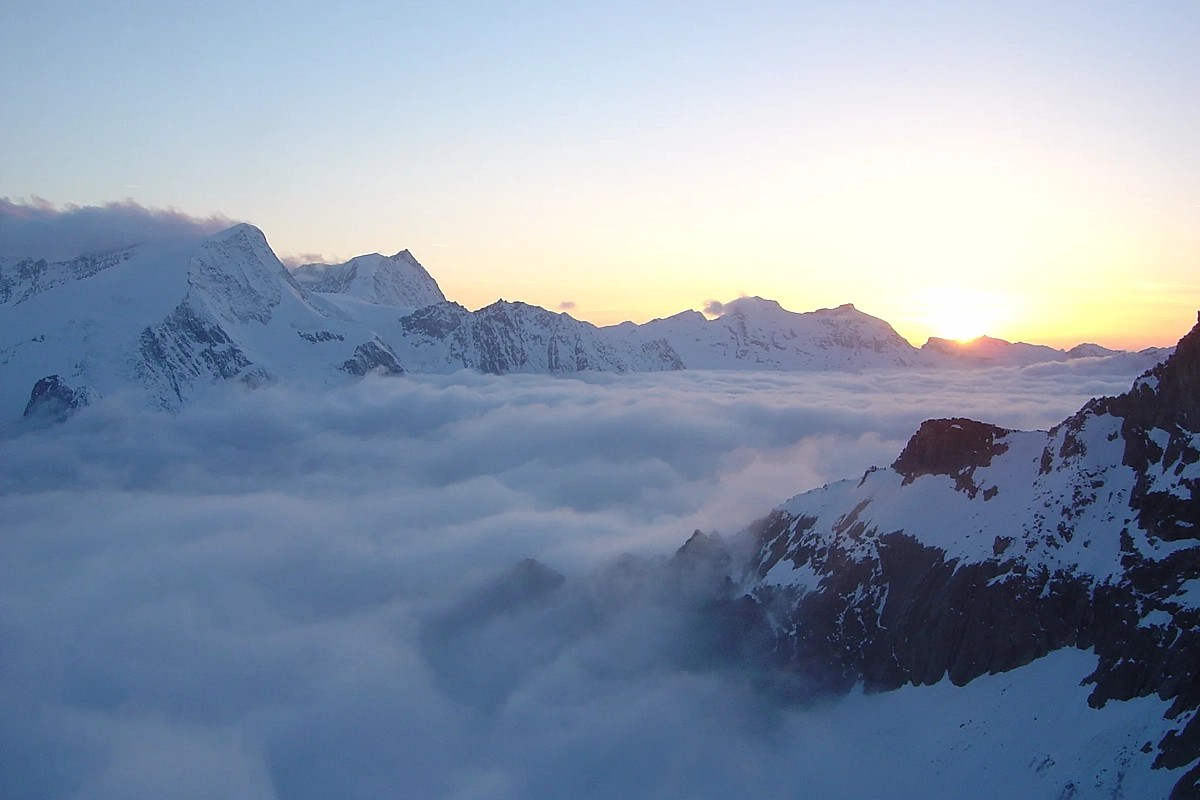
You will start on a cable car to the top of the mountain. The transition in environment is dramatic. At the bottom, it may be a warm summer morning. At the top, you step out into a different world: high-altitude cold, thin air, with a panorama like nothing else.
Your guide will help you fit crampons here, at the cable car station, on firm ground. The process takes a few minutes and requires no special knowledge. Then you step onto the glacier. The sound is the first thing most people notice: the particular crunch of crampon points biting into ice. The ice underfoot is a deep, mineral blue in the shadowed sections, shifting to brilliant white where the sun hits directly, and sometimes a translucent grey where the ice is thin enough to suggest depth below. The route traverses the glacier towards the French border, taking approximately two to three hours of walking. Your guide will maintain a steady, unhurried pace with frequent stops to point out a crevasse (from a safe distance), to explain how a particular serac formed and to let you stand in silence and simply absorb where you are.
What to wear and bring
Your guide will discuss kit in detail during the planning process, but the essentials for a glacier hike in our region include the following: stiff-soled mountaineering or hiking boots, layers including a mid-layer and a wind-proof shell, high-factor sunscreen and quality sunglasses which cover the sides as well as the front. You’ll also need water and plenty of snacks as altitude increases both thirst and energy expenditure. Finally, and crucially, don’t forget your camera.
When can you do it?
Glacier hiking in the Mont Blanc region is available from approximately May through October, though the optimal window is June to September. We typically include glacier options in our summer hiking safaris for guests who want them, tailoring the route and technical level to the group’s fitness and confidence. It is also possible to design a safari specifically around glacier access — combining a base in a mountain town with multiple high-altitude days and helicopter access to remote glacier terrain.
A note on the glaciers themselves
It would be dishonest to write about glacier hiking in 2026 without acknowledging the context: the glaciers of the Mont Blanc massif are retreating. The Mer de Glace above Chamonix has lost metres of depth annually for decades. Satellite images of the region over the past fifty years show a visible and sobering reduction in ice extent. Walking on a glacier today is not the same experience it would have been for a guide working here thirty years ago. Some routes that existed then no longer exist. The scale of the ice is diminished.
This makes the experience, for our guides, something they hold with particular care. They know these glaciers as intimately as one knows a place lived in and loved. Walking them with guests is, among other things, an act of bearing witness — to something extraordinary that exists today and may be significantly different within a generation. It is one more reason to go now, and to go with someone who knows what they are showing you.
Warmest regards from the mountains,
Danielle