



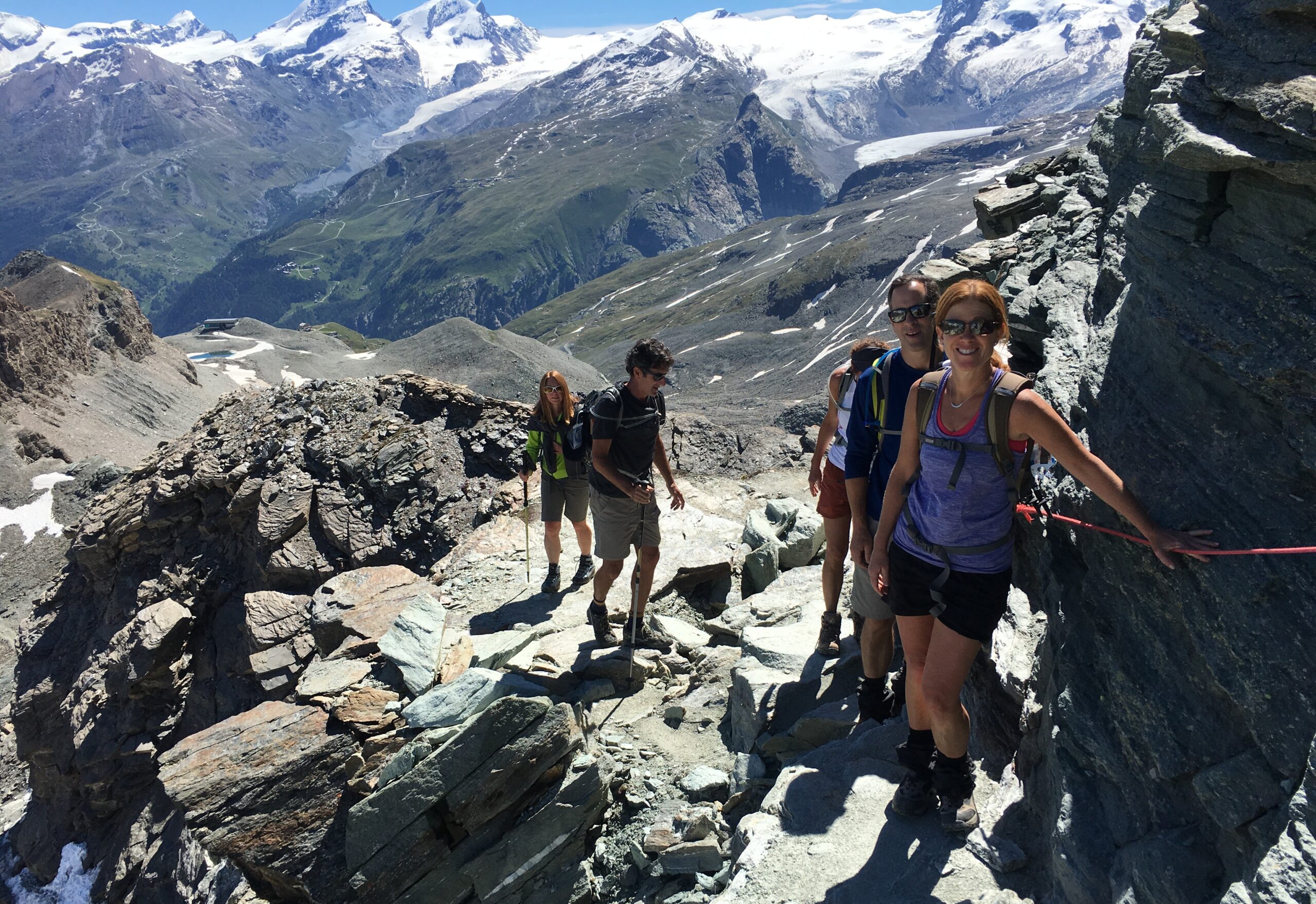
16 Jun Hiking from Switzerland to Italy: the ancient routes across the Alps

Hiking from Switzerland to Italy via ancient routes across the Alps is an extraordinary experience seeped in history, You may have previously crossed the Alps in an aeroplane or through the Mont Blanc tunnel by car or train. These are, from an historical perspective, very recent ways of doing things. For most of human history, crossing the Alps meant walking. The same high passes which our guides use today were used by the Celts, Romans, medieval pilgrims and Napoleonic armies. Hiking on an unmarked cross-border route means following the paths that shaped European history.
The Aosta valley: Europe’s oldest mountain highway
The valley of Aosta is one of the oldest continuously inhabited regions in the Alps. Archaeological evidence places settlements here as far back as the 10th century BC. Then, the valley was used as a crossing point between what is now France and Italy. The Romans recognised immediately that roads were needed to reach modern Aosta, the infrastructure of which is still visible today. The Great Saint Bernard Pass, used by Julius Caesar, Napoleon, and countless thousands of medieval pilgrims, sits at 2,469 metres altitude between Switzerland and Italy. It is guarded by a hospice built in the 11th Century to shelter Alpine travellers.
What the border crossing actually feels like
Guests often use phrases like “quietly extraordinary” to describe the particular moment when crossing international borders at altitude. On a trail around 2,300 metres high the terrain shifts imperceptibly. The vegetation changes slightly, the quality of light seems different, the path underfoot changes character. And then your guide says, quietly, “We just crossed into Italy.” There is no fence, simply a sign indicating that you are now in Italy. The border between Switzerland and Italy at altitude is in an impressive high alpine landscape, and the mountain itself ignores its existence entirely.
You will see evidence of the shift in smaller things as you go. The rock walls of the high pastures are built differently and the rooflines of the first buildings you encounter have a different pitch. And then, someone will ask you whether you would like a coffee in Italian.
Three countries, three cultures, one safari
What makes a cross-border hiking safari in our region genuinely distinctive is the cultural depth of the transition. Switzerland and Italy are not simply two countries that happen to share an Alpine border. In the valleys and passes where they meet, they have been in conversation for millennia. Trading, marrying, fighting, sharing recipes, exchanging saints’ days, architectural styles and musical traditions have all shaped the people. The result is a culture that is neither purely Swiss nor purely Italian, but something particular to this exact geography.
The French influence from the Savoie region to the west — visible in the language and in the food, which tends towards butter rather than olive oil —creates a region that is genuinely unlike anywhere else in Europe.
Walk across it with a guide who can read all three cultures fluently and you will see and learn things which you wouldn’t discover alone.
Warmest regards from the mountains,
Danielle