



28 Jul Heli-Ski itinerary 101 | SwisSkiSafari

By Danielle Stynes, Founder, SwisSkiSafari
There is a particular kind of heli-ski itinerary that circulates in the luxury travel market. It is beautifully written. It moves confidently between famous resort names — St. Moritz on day one, Zermatt on day three, perhaps a day in the French Alps somewhere in the middle. It promises helicopter drops from iconic summits. It suggests that on a ten-day trip, you might cover three countries by air. It reads like a dream.
Most heli-ski itinerary are not like this
Specialist operators know exactly what the mountain will and will not allow, and they design accordingly. But when a trip is put together by a non-specialist — a chalet company adding a “heli day” to a package, a generalist luxury travel designer working from resort brochures — the itinerary often promises things that, in the experience of someone who has been running heli-ski operations in the Swiss and Italian Alps for twenty years, the Alps simply cannot deliver.
This is rarely deliberate. The people who write these itineraries are often skilled travel professionals who know their luxury hotels and their five-star wine lists and their airport transfer logistics. What they frequently do not know — because they have not spent a winter on the mountain, watching the weather, talking to pilots, assessing snowpack — is what a helicopter can and cannot do in the Alps in January.
I want to explain the difference. Not to embarrass anyone, but because our guests deserve to understand what they are buying — and because the gap between a well-marketed heli-ski itinerary and a well-operated one is, in practice, enormous.
The first thing to understand: a helicopter is not a train
A glossy itinerary might use a helicopter the way a train timetable uses a train: as a reliable means of getting from A to B on a specific day at a specific time. Day three: helicopter transfer from Zermatt to St. Moritz. Day six: helicopter from Courmayeur to Verbier.
This is not how helicopters work in the Alps in winter.
A helicopter is one of the most weather-sensitive vehicles on earth. Wind speed and direction at altitude, cloud base and visibility, turbulence in the mountain corridors between valleys — any one of these can ground a helicopter completely, often with very little warning.
A weather window that looks clear at 7am can close entirely by 9am. A corridor that was flyable yesterday is impassable today.
We do not promise helicopter transportation between ski stations on specific days, because we cannot guarantee it. No honest operator can. The Alps in winter are not a controlled environment.
What this means in practice is that any itinerary which schedules helicopter transfers between resorts as a fixed logistical component — the way you might schedule a train connection — is making a promise that the mountain cannot keep. When the weather closes in on day three and the helicopter cannot fly, what happens to your itinerary? Who absorbs the cost of accommodation that was booked at the other end? Who arranges the alternative?
A well-designed trip builds around this reality from the start. It does not depend on helicopter transportation. If the helicopter flies, it is a spectacular bonus. If it does not, the trip is still excellent — because it was planned that way.
The second thing: you cannot heli-ski in France
This is not a nuance or a grey area. It is the law.
Heli-skiing — the dropping of passengers by helicopter in mountain zones for leisure purposes — has been illegal in France since 1985.
The ban covers the entire country. There are no designated mountain landing zones for leisure helicopter drops. The law is clear.
Any itinerary that promises heli-skiing in France — including in the Chamonix valley, in the Trois Vallées, in any French resort — is almost always the work of someone who does not know the law.
Workarounds exist at the margins of the law — drops on the Italian side of a pass that descends towards France, or helicopter recoveries lower in the valley — and the law has been progressively tightened around them, most recently in 2022, when pick-ups in classified mountain zones and even the advertising of such activities were prohibited. Whatever the fine print in a given valley, these are workarounds for a ban. They are not what most clients picture when they read “heli-skiing in France” in an itinerary, and we do not build trips on them.
In our region — where Switzerland, Italy and France all converge — we design heli-ski programmes specifically around the two countries where heli-skiing is legal: Switzerland and Italy. The two offer genuinely different heli-skiing: different terrain, different drop zones, different character. That is precisely why we like to combine them on a single trip. It also gives us something more practical: this corner of the Alps is a patchwork of micro-climates, and when conditions close in on one side of the border, they are often open on the other. Operating across both countries means we are never waiting on a single valley’s weather.
A well-designed programme uses both. It does not pretend France is available when it is not.
The third thing: the number of drops is not fixed in advance
Luxury heli-ski itineraries often quote a specific number of drops — “three drops per day” or “twelve drops over the week.” These numbers look impressive in a brochure. They are essentially meaningless in the European Alps.
The number of drops on any given day is a function of weather, snowpack, available helicopter time, terrain accessibility, and — critically — the fitness and technical ability of the group. On a perfect day with ideal conditions and a well-matched group, three drops is achievable and magnificent. On a day with variable weather and a group that needs more time between runs to recover, one drop might be the right answer. On a day when conditions at the planned drop zones are unsafe, zero drops is the correct answer — and a good guide will not try to talk a pilot into flying in conditions that are not right simply because the itinerary says “heli day.”
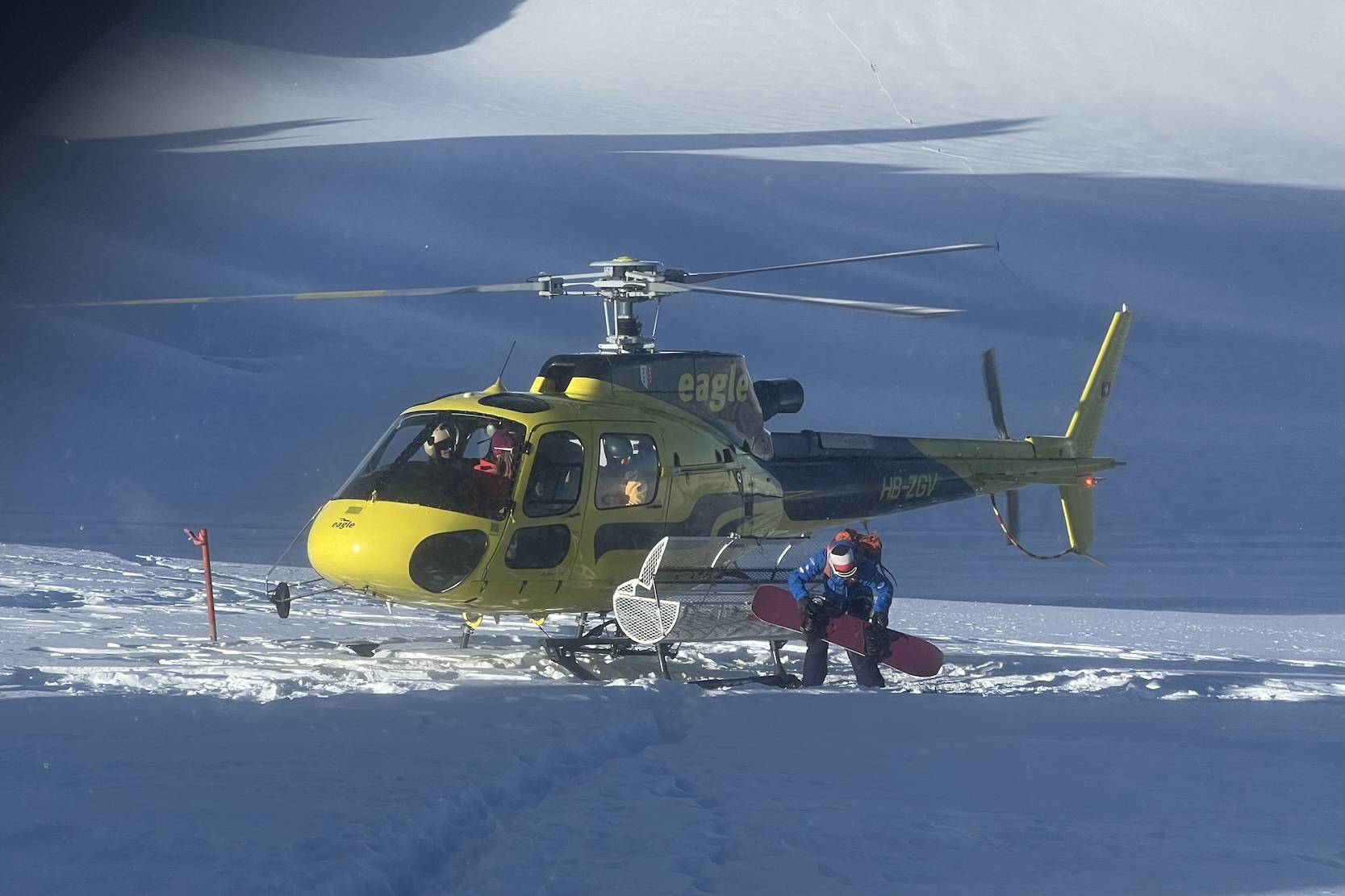
The margins can be remarkably fine. On one successful day, the weather was good but visibility at high altitude was marginal: our pilot asked us to drop one of our red backpacks onto the summit so that he could judge the landing. After the first few turns the visibility was perfect, and we had an almost perfect ski descent. That is the difference between a day that flies and a day that does not — and no brochure written in an office can predict it.
Two or three drops in a week, across a trip that includes other skiing, is a realistic and excellent outcome for most heli-ski clients. Anyone who tells you otherwise has either been extraordinarily lucky with conditions, or is telling you what you want to hear.
What does a well-designed heli-ski itinerary in the Alps look like?
If fixed transfers, French drop zones and guaranteed drop counts are the warning signs, what does a well-operated heli-ski safari actually involve? That deserves a proper answer — private groups, why you ski together before anyone flies, and why seven days is the right length. We cover all of it in Part 2: What a Real Heli-Ski Itinerary Actually Looks Like.
Frequently asked questions
Is heli-skiing legal in France?
No. Dropping passengers by helicopter in mountain zones for leisure has been illegal in France since 1985, and the rules were tightened further in 2022. Heli-skiing is legal in Switzerland and Italy, which is where SwisSkiSafari operates.
How many helicopter drops can I expect in a week?
Two or three drops across a week, alongside excellent guided off-piste skiing, is a realistic outcome in the European Alps. On an exceptional week it might be four. Anyone promising a fixed number of drops per day is promising something the weather does not allow them to promise.
Can a helicopter transfer me between ski resorts on a set day?
It cannot be guaranteed. Helicopters in the Alps in winter are grounded by wind, visibility, icing and turbulence, often at short notice. A well-designed trip treats any helicopter transfer as a bonus, never as fixed logistics.
Talk to us about planning your heli-ski safari or give us a call directly +41 79 239 41 52.
Warmest regards from the mountains,
Danielle
Danielle Stynes is the founder of SwisSkiSafari and has been guiding and operating heli-ski programmes in the Swiss and Italian Alps for over twenty years. SwisSkiSafari designs exclusively private, bespoke heli-ski and ski safari experiences for small groups.