



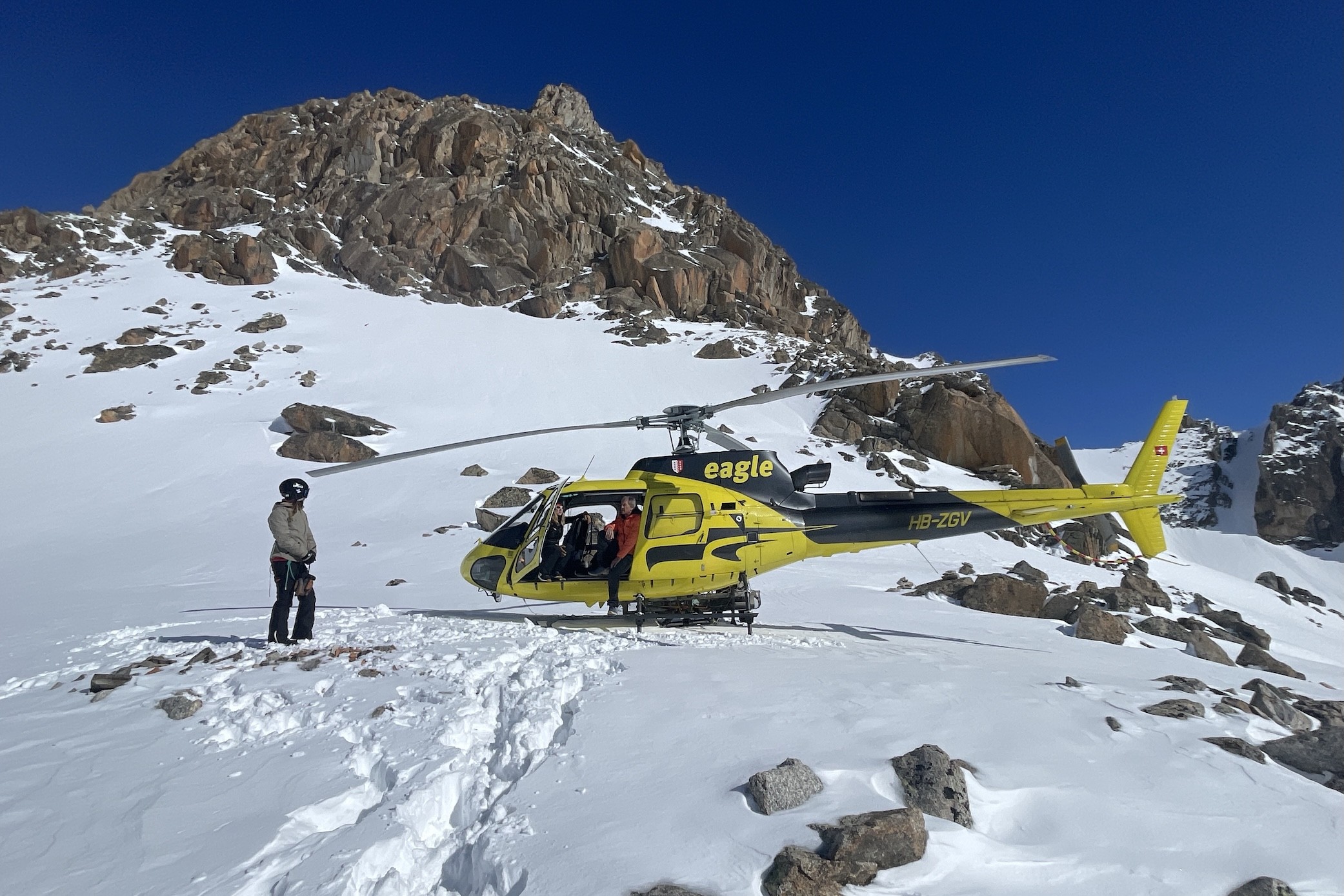
07 Aug What a real heli-ski itinerary looks like

In our last blog we explained what heli-ski itineraries designed by non-specialists tend to get wrong. We mentioned the fact that helicopters cannot be scheduled like trains, heli-skiing is illegal in France, and nobody can honestly promise a fixed number of drops. This article is the other half of the story. We include what a well-operated, honest heli-ski safari actually looks like, based on twenty years of running them in the Swiss and Italian Alps.
Ski first, fly later
The most important operational point that luxury travel brochures never mention is this.
Heli-skiing drops your whole group onto a remote summit. This is usually far from any lift or pisted run with terrain that can be steep, icy, heavily laden with fresh snow, or cut through with crevasses depending on the location. Your guide is responsible for everyone’s safety on the descent. In that environment, it matters whether your guide knows how each person in the group skis. They need to understand their reaction time, their technical range, how they behave when they are frightened and how they communicate out of their comfort zone.
Strangers equal stress in this environment. Or, at worst, danger. Understanding your group members is key when you’ve been dropped onto a 3,000-metre summit. Every trip we run is private and we never mix groups. The leader of the group has invited the participants personally. Before the trip starts we assess their ability, their fitness, their appetite. There is no assembling of strangers at the helipad. By the time the trip begins, we already know who we are designing for.
We do not do it. This is one reason every trip we run is private.
How do we do it?
We always begin heli-ski trips with two days of guided off-piste skiing before any helicopter is involved. Here are three reasons why.
First, this allows our guide to assess each skier’s ability in steep, ungroomed, variable conditions that resemble the heli terrain, without the stakes of a remote summit. If someone is not at the level required for the planned drops we can adapt the programme accordingly. This is a kindness to that guest, not a judgement. Heli-skiing has a genuine ability threshold, and it is not one that can be assessed from a self-reported skill level on a booking form.
Second, it allows the group to ski together. By the time you step into a helicopter, you should know the people you are flying with. This includes how they ski, how they communicate and how they make decisions on the mountain.
Third, it builds the specific fitness required. A heli-ski descent of 1,500 to 2,500 vertical metres is physically demanding in a way that resort skiing rarely is. The group will arrive at the summit with legs that are ready if they ski for two days first.
What a realistic heli-ski programme actually looks like
We do not publish day-by-day itineraries. This is because we never know exactly what we are going to do, but a well-designed heli-ski safari does have a shape.
Most trips are around seven days long. A week is the comfortable length for almost everyone: long enough to do it properly, short enough that legs and enthusiasm hold to the end. Heli-skiing genuinely needs this much time to allow for a good weather window.
After the first two days of guided, off-piste skiing, we start every day with a heli-drop as the goal and a full off-piste day as the guaranteed alternative. We always have several helicopter companies on standby to ensure someone is ready when the window opens. A good window can close in two hours. The skiing is still excellent on non-flying days: our guides know terrain most guests would never find on their own. Because we operate across both Italy and Switzerland, we can follow the weather rather than wait for it. This means moving between valleys and even countries with a guide who knows which valley restaurant has been holding a table for you since this morning.
Clients get two, three, or, on an exceptional week, four helicopter drops. They will also have skied some of the finest off-piste terrain in the Alps and eaten in places they would never have found.
That is a genuine heli-ski safari. It is different in almost every respect from a beautifully formatted itinerary that promises the sky and cannot guarantee the weather.
Why this matters
We tell the truth, not simply what clients want to hear. The Alps will not bend to an itinerary. The weather will not cooperate because a luxury travel magazine featured the area this week. The helicopter will not fly because the booking confirmation says it should. Our expertise means we provide an experience that exceeds what clients imagined.
What we can promise is this: a small, private group of people who ski at the right level, with guides who have spent their lives in this terrain, with flexibility built into every day. Not to mention the infrastructure — the pilot relationships, the alternative routes, the local knowledge — to make the most of every window the mountain offers.
When it all comes together, there is nothing like it.
Frequently asked questions
How long should a heli-ski trip be? Around seven days. Heli-skiing needs enough time in the mountains for a good weather window to open. Twenty years of experience shows a week is the length that suits almost every group: long enough to do it properly, short enough that legs hold to the end.
Do you mix groups? Never. Every SwisSkiSafari trip is private: the group leader invites the participants, and the trip is designed around those specific skiers from the first conversation.
Do I need to be an expert skier? You need to be a strong, fit off-piste skier. Every programme begins with one or two days of guided off-piste skiing before any helicopter is involved, so the guide can assess each skier honestly and adapt the programme before anyone flies.
What happens on days the helicopter cannot fly? You ski, and ski well. Every day is planned with a heli-drop as the goal and a full guided off-piste day as the guaranteed alternative. This will be in terrain most guests would never find on their own, across both Switzerland and Italy.